


AI Agents Don’t Need More Databases. They Need Better Memory.
Imagine a retail analytics agent that has investigated hundreds of sales problems across a chain of 120 stores. It can query the data warehouse, retrieve historical reports, call business APIs, and generate detailed recommendations. Yet, when a familiar problem appears, it recommends the same action that failed previously.
Consider a merchandising manager investigating declining sales of packaged beverages. The agent identifies a correlation between a discount campaign and falling category profitability. It recommends changing the pricing strategy. The recommendation fails because several stores had experienced stockouts during the campaign. Two weeks later, another category experiences a similar decline. The agent recommends a discount again.
The problem is not a lack of data. The agent has access to the sales records, inventory history, promotion details, and previous investigation. What it lacks is a reliable mechanism for turning experience into useful knowledge.
It needs to distinguish an observation from a hypothesis, a hypothesis from a verified finding, and a one-time outcome from a lesson that can safely influence future decisions. This is the difference between an agent that can retrieve information and one designed to learn from its experience.
AI agents don’t necessarily need more databases. They need better memory systems that determine what to retain, how to use it, and when not to trust it.
1. The Database Was Never the Problem
Databases remain among the most important components of enterprise software. A retail analytics platform depends on them to store sales transactions, inventory movements, product information, pricing, and promotional history.
These systems answer questions such as:
- How many units of a product sold yesterday?
- What was the gross margin for a particular category?
- Which stores experienced stockouts?
- Which products were included in a promotion?
The answers should come from authoritative business systems, not from an LLM’s recollection of an earlier conversation.
AI agents introduce a different class of questions.
- Why did the previous investigation attribute the sales decline to stock availability?
- Which analytical checks have already been performed?
- Did the proposed intervention work?
- Which lessons from earlier investigations are relevant to the current problem?
A database can store the records needed to answer these questions. But the application still needs logic to identify relevant experiences, interpret their significance, and determine whether their conclusions apply to a new situation.
Retrieval-augmented generation (RAG) helps by finding relevant documents or passages. A vector database can retrieve a previous investigation whose subject resembles the current problem. Neither mechanism, by itself, guarantees that the agent will distinguish a verified cause from an untested hypothesis.
This is where memory becomes an architectural concern.
A useful distinction is:
- Database: What are the authoritative records?
- RAG: Which external information is relevant to this question?
- Agent memory: Which facts, experiences, preferences, and procedures should influence this task?
These responsibilities overlap, but they are not interchangeable.
Research on AI agent memory increasingly treats memory as more than a storage mechanism. Hu et al.’s 2025 survey, Memory in the Age of AI Agents, distinguishes memory by its form, function, and dynamics, emphasizing that traditional short-term and long-term categories do not adequately describe the field (paper).
The implication for system designers is straightforward: memory should be designed around the work an agent must perform, not simply the technology used to store its information.
2. What Should an AI Agent Remember?
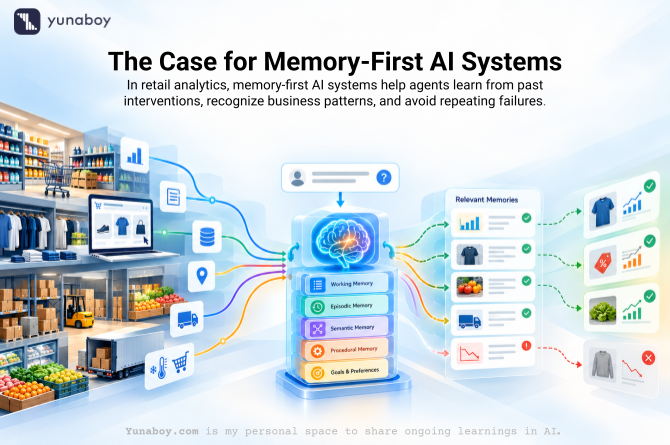
A useful memory architecture starts by identifying the different kinds of information that can improve an agent’s future work. The familiar distinction between short-term, episodic, and semantic memory is a useful starting point. For practical agent design, however, we also need to consider procedures, goals, and future commitments.
These are different memory functions, not necessarily separate databases.
Working memory: What matters right now?
Working memory contains the information needed to complete the current task: the user’s question, active hypotheses, retrieved evidence, intermediate findings, and unresolved steps.
For a retail analytics agent, this might include the affected product category, the investigation period, the stores involved, and the current hypothesis that a sales decline was caused by poor availability. Without working memory, the agent may repeatedly reconstruct its investigation or lose track of the relationship between its evidence and its conclusions.
Working memory should remain focused on the current task. It does not need to preserve every intermediate calculation indefinitely.
Episodic memory: What happened before?
Episodic memory records meaningful experiences: what the agent investigated, which actions it took, what happened, and under what circumstances.
Suppose an agent previously analyzed a promotion across 12 stores. Unit sales increased, but gross margin fell and total category profit did not improve.
A useful episodic memory would preserve the experiment’s scope, the action, the outcome, and the supporting evidence. Simply storing the sentence “discounts reduce profitability” would be dangerous. The experiment might have involved one category, one period, and a specific pricing strategy. The result does not automatically apply everywhere.
Episodic memory is valuable because it gives the agent access to the history behind a conclusion rather than only the conclusion itself.
Semantic memory: What do we know?
Semantic memory contains reusable facts, definitions, relationships, and established knowledge.
A retail agent might retain the meaning of gross margin, the relationship between products and categories, or an approved rule governing a particular store format. It can also contain a carefully validated finding such as: “In the original pilot, reduced availability was associated with a substantial portion of the observed sales decline.”
The important distinction is that semantic memory should contain knowledge that can be reused beyond the original event, while episodic memory preserves the context in which the knowledge was established.
A fact extracted from an episode should not automatically become a general rule.
Procedural memory: How should the agent do the work?
Procedural memory is particularly important for business agents because reliable performance often depends on following a repeatable method.
Consider a retail sales investigation. Before recommending a price change, an agent might be required to:
- Check data completeness and sales trends.
- Verify product availability.
- Examine price changes and promotions.
- Compare relevant stores and periods.
- Investigate seasonality and other plausible explanations.
- Present evidence and uncertainty before recommending an intervention.
This procedure is more valuable than remembering a previous recommendation alone. It gives the agent a reusable approach for investigating new problems.
Procedural memory can also include approved SQL patterns, tool-use instructions, analytical checklists, and validated workflows.
However, not every successful execution deserves to become a procedure. A workflow should be checked for correctness, permissions, and applicability before it is promoted for reuse.
Goal and preference memory: What matters to this decision-maker?
Different stakeholders can have different objectives.
A merchandising director might prioritize gross-margin improvement. A supply-chain manager might focus on availability. A store manager might care about reducing waste and avoiding lost sales.
A memory-enabled agent should retain relevant, explicitly stated objectives and constraints, with clear ownership and scope.
It should not confuse an inferred preference with a confirmed instruction. A manager who requests a margin analysis once has not necessarily declared that margin should override every other business objective.
When preferences conflict, the agent should recognize the conflict rather than silently choosing one.
Prospective memory: What needs to happen later?
Some useful memories concern future actions rather than past events.
A merchandising agent might need to reassess a promotion after two weeks, once enough post-campaign sales and margin data are available.
The memory should preserve the intended follow-up, why it matters, and the condition under which it becomes relevant. A scheduler or workflow engine can handle execution. This is different from merely remembering that a promotion occurred. It allows an agent system to carry forward unfinished work and planned evaluations.
Together, these memory functions provide a more practical foundation than treating all long-term information as one collection of conversation summaries.
3. Memory Must Be Engineered as a Lifecycle
Identifying memory types is only the beginning. The harder question is how information moves from an interaction into a form that can reliably influence future work.
A memory-first architecture needs a controlled lifecycle.
Experience → Extraction → Classification → Validation → Storage → Retrieval → Evaluation → Revision or deletion
Consider the retail investigation again.
The agent observes a sales decline and retrieves inventory records. It considers several explanations, investigates stock availability, and eventually establishes that stockouts contributed to the decline.
At the end of the investigation, the system should not simply save the entire transcript and hope that a future similarity search retrieves the right portion.
It should identify potential memory candidates.
One candidate might be an episodic record of the investigation. Another might be a reusable analytical insight. A third could be an improvement to the investigative procedure. Each candidate needs to pass an appropriate validation process.
For example, the system should verify that the stockout conclusion is supported by the available data, that the time periods align, and that the result was not merely inferred from correlation. If the cause remains uncertain, the memory should preserve it as a hypothesis rather than a verified finding.
Only after this process should the information become eligible for long-term reuse.
Deciding what deserves to be remembered
A retail agent might generate hundreds of observations during a single investigation. Retaining all of them indefinitely creates unnecessary retrieval noise and storage costs.
A practical memory policy should consider:
- Future usefulness: Is the information likely to help with another task?
- Evidence quality: Is it supported by reliable sources?
- Reusability: Does it apply beyond one conversation?
- Novelty: Does it add anything to existing memory?
- Risk: What happens if the information is wrong?
- Scope: Under which conditions is it valid?
These criteria are a proposed engineering framework, not a universal scoring formula. Different applications should assign different weights to them.
For example, an unverified hypothesis may be worth retaining temporarily within an active investigation but unsuitable for long-term semantic memory. A verified procedural improvement might be worth retaining for much longer.
Choosing the right representation
There is also a trade-off between preserving detail and making retrieval efficient.
A raw conversation preserves nuance but contains irrelevant discussion, repetition, and potentially conflicting claims. A short summary is cheaper to retrieve but may erase the difference between evidence and speculation.
A structured experience record can preserve the important parts separately:
- Investigation objective.
- Relevant entities and time period.
- Observations and supporting evidence.
- Hypotheses considered.
- Actions performed.
- Verified outcome.
- Limitations and applicability conditions.
- References to the original records.
This representation makes it easier for the agent to retrieve a concise memory while returning to the underlying evidence when necessary.
The goal is not to preserve every word. It is to preserve the information required for future reasoning without losing the context that makes it trustworthy.
4. Retrieval Is More Than Similarity Search
A memory system can store excellent information and still fail if it retrieves the wrong memories.
Suppose the agent is investigating falling beverage sales in metropolitan supermarkets. It retrieves a previous investigation of a similar sales decline in rural convenience stores. The two cases may be semantically similar, but their supply chains, customer behavior, product mix, and operating constraints could differ substantially.
A reliable retrieval policy should consider more than semantic similarity.
It should examine:
- Relevance to the current question.
- Matching products, stores, categories, and business conditions.
- Evidence quality and verification status.
- Whether the finding has been superseded.
- The period and conditions under which the finding applies.
- The potential consequences of using an incorrect memory.
Retrieval should also depend on the task.
- If a manager asks for yesterday’s sales total, the agent should query the analytics warehouse. Historical memories are unlikely to improve the answer.
- If the manager asks why a recurring category problem keeps happening, relevant investigations and validated procedures become much more useful.
For a recommendation, the agent may need both: authoritative current data from business systems and relevant memories that explain previous outcomes.
This is a central principle of memory-first design: retrieve information because it can improve the decision, not merely because it resembles the question.
5. Preventing Memory Pollution
The most overlooked challenge in agent memory is that adding information does not always make the system better.
An agent can accumulate duplicate observations, stale procedures, unsupported conclusions, and lessons that apply only to a narrow set of circumstances. Over time, these memories can compete for attention or bias later decisions.
Call this memory pollution: the accumulation or reuse of information that reduces the reliability of future reasoning.
Research provides reasons to take this problem seriously.
Xiong et al.’s study, How Memory Management Impacts LLM Agents (ACL 2026), investigates how memory addition and deletion affect agent behavior. The authors identify error propagation and misleading experience reuse, showing why memory quality must be managed rather than allowing memory to grow indiscriminately (paper).
Uddin et al.’s From Recall to Forgetting (Findings of ACL 2026) introduces the Memora benchmark and a metric that penalizes reliance on obsolete or invalidated information. Its evaluations report frequent reuse of invalid memories and failures to reconcile evolving information (paper).
These findings point toward several practical guardrails.
Separate evidence from conclusions
If sales declined during a promotion, do not automatically store “the promotion caused the decline.”
Record the observation, the competing hypotheses, the supporting evidence, and the verification status separately. Require sufficient evidence before promoting a hypothesis into reusable knowledge.
Deduplicate carefully
Repeated observations about the same stockout problem should not produce dozens of competing memories.
However, similar statements must not be merged blindly. Two investigations may have similar wording but different products, regions, or outcomes. Consolidation should preserve meaningful differences.
Preserve scope and provenance
Every important finding should retain references to the evidence that supports it.
A memory should indicate whether it came from an authoritative business record, an analytical result, a human-confirmed conclusion, or an LLM-generated inference.
It should also preserve relevant scope: the stores, products, dates, or conditions under which the finding was established.
This makes it harder for an unsupported summary to gradually acquire the appearance of a verified business fact.
Handle outdated information explicitly
An old pricing procedure may no longer be valid after a policy change. A previously successful intervention may stop working when market conditions change.
Memory systems need mechanisms to mark information as superseded, expired, or awaiting validation.
Not every memory should decay at the same rate. A stable business definition may remain useful for years, while a promotion result may become irrelevant after a seasonal change.
Control memory writes
Documents, reports, and user-provided content can contain incorrect claims or malicious instructions. Retrieved content should not automatically be allowed to rewrite trusted procedures or organizational rules.
Memory writes should respect authorization, tenant boundaries, validation requirements, and the distinction between untrusted evidence and approved instructions.
Make forgetting deliberate
Forgetting does not necessarily mean deleting historical records.
It can mean removing a duplicate, excluding a stale memory from normal retrieval, demoting an unverified conclusion, or revoking a procedure that is no longer approved.
Where audit or regulatory requirements apply, the underlying evidence may need to remain in a separate authoritative system even when it should no longer influence the agent’s recommendations.
The objective is not to build the largest possible memory. It is to maintain the smallest reliable collection of information that supports the agent’s work.
6. A Practical Architecture for Memory-First Agents
A production architecture should connect memory functions to the agent’s existing tools and data sources rather than treating memory as a replacement for them.
A simplified design looks like this:
User request → Agent → Memory retrieval policy → Relevant memories and business data → Reasoning → Recommendation
The memory layer contains working, episodic, semantic, procedural, goal/preference, and prospective memory functions as required by the application.
A governance component controls memory creation, validation, consolidation, retrieval eligibility, and retention. Outcome evaluation determines whether a previous memory was useful and whether it should be revised.
Meanwhile, the agent continues to use SQL, APIs, document retrieval, and other tools to obtain current and authoritative information.
Consider an investigation of falling snack sales:
- The agent queries the warehouse for sales, price, promotion, and inventory data.
- It retrieves relevant past investigations and approved analytical procedures.
- It uses working memory to organize the current hypotheses and evidence.
- It checks whether previous findings apply to the affected stores and period.
- It recommends an action supported by current evidence.
- After the outcome becomes available, the system evaluates whether the investigation produced a reusable lesson.
- A candidate memory is retained only if it meets the applicable validation and retention rules.
This architecture does not require a separate database for every memory type. Structured storage, vector indexes, graph representations, and ordinary application services can be combined according to the retrieval and governance requirements.
The architectural distinction is between the purpose of a memory and the technology used to implement it.
Mem0 is one example of a framework that automates memory extraction, updates, and retrieval. Its research demonstrates a practical approach to persistent conversational memory, but a framework alone does not eliminate the need for application-specific validation, authorization, and evaluation (Mem0 paper).
7. Measuring Whether Memory Actually Helps
A memory system should not be judged only by whether an agent can recall something from a previous conversation.
The more important question is whether memory improves future performance without introducing harmful information.
For a retail analytics agent, evaluation should cover several dimensions.
- Recall: Can the agent retrieve the verified cause of a previous sales decline?
- Correctness: Can it distinguish an observed correlation from a confirmed explanation?
- Applicability: Does it avoid using findings from the wrong store format or product category?
- Update handling: Does it stop relying on an obsolete pricing procedure?
- Procedural compliance: Does it follow the approved investigative method?
- Memory pollution: Does adding irrelevant or incorrect memories degrade the quality of recommendations?
- Efficiency: How many tokens, retrieval operations, and tool calls are required?
- Business utility: Do recommendations improve a predefined outcome, such as margin, availability, or investigation time, without violating operational constraints?
These measures should be tested against meaningful baselines: an agent without persistent memory, one using raw conversation retrieval, one using summaries, and one using a governed memory architecture.
The tests should include difficult cases such as contradictory evidence, duplicate memories, outdated conclusions, and findings that do not apply to the current situation.
Research benchmarks can help, but retail-specific tasks are essential. A benchmark that measures conversational recall does not automatically establish that a merchandising agent can make better business decisions.
The evaluation must reflect the work the agent is expected to perform.
Conclusion: Better Memory Is an Engineering Discipline
The retail agent that repeatedly recommends discounts for stockout-driven sales declines does not need another database simply to retain more information. It needs a reliable way to preserve evidence, learn from outcomes, follow validated procedures, and retrieve relevant experience without confusing a historical hypothesis with an established conclusion.
That requires deliberate choices about what to remember, how to represent it, when to retrieve it, and when to revise or forget it.
Databases remain essential for authoritative records. RAG remains useful for finding relevant documents. Memory adds another capability: it allows selected knowledge and experience to influence future work in a controlled, testable way.
This is why memory-first design is not simply a matter of adding a vector store or summarizing conversations. It is an engineering discipline built around memory quality, retrieval relevance, provenance, validation, and continuous evaluation.
The next generation of AI agents will not be defined by how much information they can access, but by how intelligently they decide what is worth remembering.
References
- Hu, Y. et al. (2025). Memory in the Age of AI Agents: A Survey. arXiv:2512.13564
- Xiong, Z. et al. (2026). How Memory Management Impacts LLM Agents: An Empirical Study of Experience-Following Behavior. Proceedings of ACL 2026. ACL Anthology
- Uddin, M. N. et al. (2026). From Recall to Forgetting: Benchmarking Long-Term Memory for Personalized Agents. Findings of ACL 2026. ACL Anthology
- Chhikara, P. et al. (2025). Mem0: Building Production-Ready AI Agents with Scalable Long-Term Memory. arXiv:2504.19413